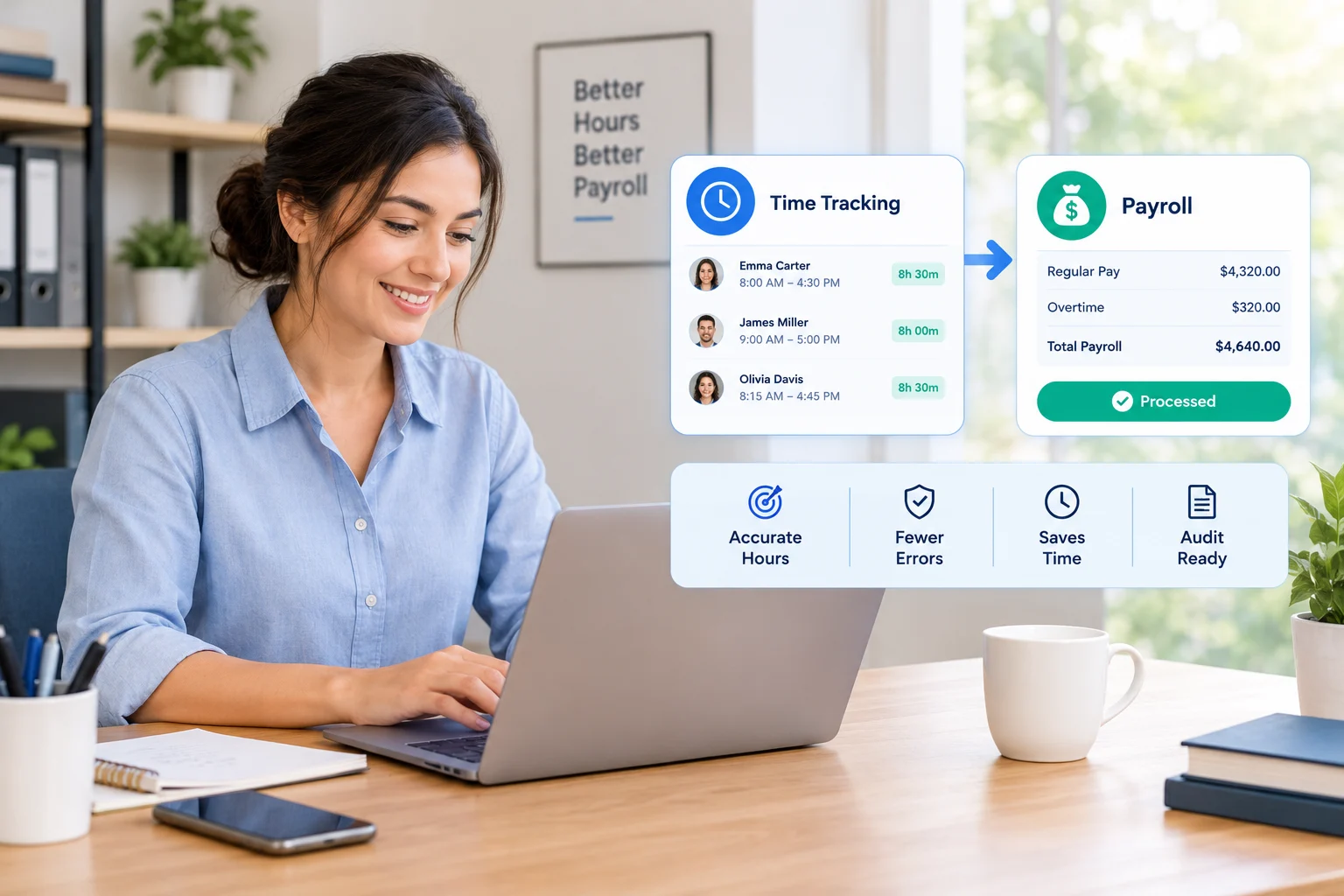
For a small business, payroll is one of the few tasks that has to be right every single time. There's no partial credit for "close enough" hours an underpaid employee loses trust, and an overpaid one costs money you didn't budget for. Yet many teams with 5–50 employees still run payroll from paper timesheets, memory, or spreadsheets that nobody double-checks until something looks off.
Accurate time tracking is the fix. When hours worked are captured correctly at the source, payroll stops being a guessing game and becomes a straightforward calculation. Here's exactly how that accuracy shows up in your payroll process and what it costs you when it's missing.
Why Payroll Accuracy Starts With Time Tracking
Payroll doesn't create errors on its own it inherits them. If a timesheet says an employee worked 38 hours when they actually worked 41, payroll will faithfully calculate wages based on the wrong number. The software isn't broken; the input was.
That's why accurate time tracking is the foundation, not a side task. Every payroll figure regular pay, overtime, and even scheduling for the next pay period depends on the hours that were logged in the first place.
Common Time Tracking Mistakes That Wreck Payroll
-
Manual entry and rounding. Employees estimating "about 8 hours" instead of clocking in and out introduces small errors that add up across a pay period.
-
Forgotten clock-outs. A missed clock-out can overstate hours by several dollars per shift, every shift, until someone catches it.
-
Disconnected systems. When timesheets live in one tool and payroll runs in another, someone has to manually retype the numbers and manual retyping is where typos happen.
-
Late or missing approvals. Without a clear approval step, unverified hours can slip straight into a pay run.
The Real Cost of Inaccurate Time Data
Small teams often treat a few minutes of rounding or a missed timesheet as trivial. Multiplied across a pay period and a full team, it isn't. Overpayments quietly erode margin, underpayments create disputes and rework, and both create extra administrative time spent reconciling numbers after the fact.
There's also a compliance angle. Under the Fair Labor Standards Act (FLSA), employers must keep accurate records of hours worked and wages paid for non-exempt employees, including daily and weekly totals. The law doesn't mandate a specific timekeeping format, but it does require the records to be accurate, and basic time and payroll records generally need to be kept on file for two to three years. Sloppy time data doesn't just cost money it creates a recordkeeping gap that can turn into a real liability during an audit or a wage dispute.
How Accurate Time Tracking Fixes Payroll Step by Step
1. It Captures Hours as They Happen
Real-time clock-ins and clock-outs replace end-of-week guesswork. Employees log actual start and stop times, so payroll is built on what happened, not what someone remembers.
2. It Removes the Manual Handoff
When timesheets feed directly into payroll instead of being retyped from a separate spreadsheet, there's no re-entry step where numbers can be transposed or dropped. The hours that were approved are the hours that get paid.
3. It Applies Overtime Correctly
Accurate daily and weekly totals make it possible to apply overtime rules consistently instead of estimating them at the end of a pay period which matters both for employee trust and for FLSA compliance.
4. It Creates an Audit-Ready Record
Every clock-in, edit, and approval is timestamped and attached to the employee record, so if a pay figure is ever questioned, there's a clear trail showing exactly how it was calculated.
5. It Speeds Up Payroll Processing
Approving a shared, accurate timesheet takes minutes. Chasing down missing hours, correcting a paycheck, or reconciling two systems after the fact takes hours sometimes every pay period.
What Connected Time Tracking Looks Like in Practice
The businesses that get this right usually have one thing in common: their time tracking and payroll aren't separate tools that occasionally sync they're part of the same system. Hours logged during the week are visible to a manager for approval, and once approved, they're ready for payroll without anyone opening a second spreadsheet.
This is also where invoicing benefits, for teams that bill clients by the hour the same verified time record that runs payroll can generate an accurate client invoice, so hours are entered once and used twice.
Hexa Piper's timesheet and time tracking module was built around this exact idea: hours are logged, approved, and pushed straight into payroll inside one workspace, with no re-entry step in between. It's one of the reasons small and mid-sized teams the kind Hexa Piper is built for use it to replace a stack of disconnected tools with a single, accurate system of record.
Getting Started With More Accurate Payroll
If your team is still reconciling timesheets by hand, the fix isn't a stricter policy it's removing the manual steps where errors get introduced in the first place. Connecting time tracking directly to payroll is the single highest-leverage change most small businesses can make to their payroll process.
Ready to see it for yourself? Start your free 30-day trial no credit card required or explore Hexa Piper's plans to see which fits your team.